
ITA Member Progress on Climate Action and Low-Carbon Transition
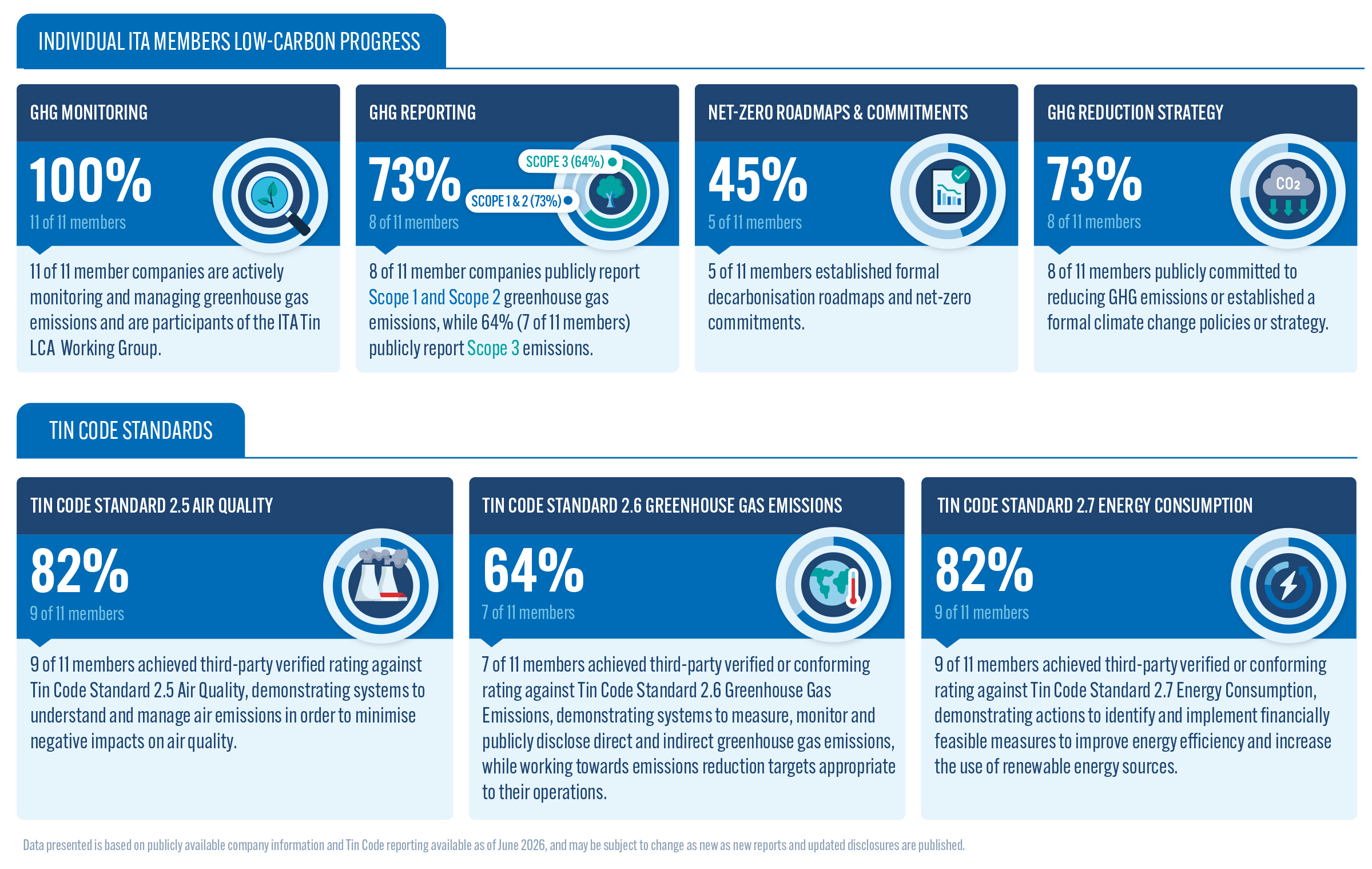
ITA supports members by improving the understanding and measurement of GHG emissions through initiatives such as its industry-wide LCA studies and LCA member working group. These initiatives strengthen collective industry action, improve transparency, and provide a clearer understanding of emissions across global tin production.
The Tin Code helps companies strengthen robust environmental management systems, improve the consistency and transparency of emissions reporting, and drive continuous improvement in environmental performance through independently assessed standards on air quality, greenhouse gas emissions, and energy management, through a progressive rating system.
ITA member companies are making significant progress in GHG reporting, emissions reduction planning and the implementation of low-carbon initiatives. By improving transparency and highlighting these individual efforts, ITA aims to better demonstrate the progress being made across the global tin industry and encourage continued collaboration and knowledge sharing to accelerate climate action. Further information on individual member company initiatives is highlighted below.
For more information on our members – see here
To learn more about the Tin Code, its standards, or to access member reports, visit the Tin Code website.
Aurubis
Aurubis, a secondary tin smelter and recycler, annually tracks and publicly reports Scope 1, Scope 2 and Scope 3 GHG emissions. The company provides transparent Environmental Footprint Declaration (EFD) Factsheets, offering product-level data on environmental impacts and sustainability performance for tin.
Under the Aurubis Group sustainability framework and climate strategy, Aurubis has set a target to reduce Scope 1 and 2 emissions by 50% by 2030 and achieve carbon neutrality for Scope 1 and 2 emissions by 2050, aligned with SBTi 1.5°C climate targets.
The site is supporting these commitments through ongoing decarbonisation initiatives, including long-term renewable energy sourcing, energy efficiency improvements and participation in wider EU industrial decarbonisation programmes.
The company has also achieved third-party verified performance under the International Tin Association’s Tin Code standards for 2.5 Air Quality, 2.6 Greenhouse Gas Emissions and 2.7 Energy Consumption.

Fenix Metals
Fenix Metals Sp. Z o.o., a secondary tin smelter and recycler, monitors and reports Scope 1, Scope 2 and Scope 3 GHG emissions as part of its environmental management processes and participation in industry LCA studies.
Under its ISO 14001 environmental management system, Fenix Metals employs best available environmental protection and control technology (BAT) and operates in compliance with Polish and European Union environmental legislation, supporting the monitoring and management of environmental impacts across its operations.
The company is also implementing operational improvements aimed at reducing energy consumption and greenhouse gas emissions as part of its broader environmental management approach.
Fenix Metals has achieved third-party verified performance under the International Tin Association’s Tin Code standards for 2.5 Air Quality, 2.6 Greenhouse Gas Emissions and 2.7 Energy Consumption.
Minsur
Minsur S.A., is an integrated tin mining and smelting company operating in Peru and annually tracks and publicly reports Scope 1, Scope 2 and Scope 3 GHG emissions through its corporate sustainability reporting.
Minsur has established a formal climate Change Policy and has developed a Board-approved Net Zero Roadmap to guide its climate strategy. They have committed to reducing Scope 1 and Scope 2 emissions by 30% by 2030 and achieving net-zero emissions by 2050, aligned with Peru’s national climate commitments and global climate goals and global 1.5 °C targets.
The company is implementing a range of decarbonisation initiatives, while strengthening its emissions measurement systems, focused on transitioning to cleaner energy sources, reducing fossil fuel use and improving operational efficiency across its mining and refining operations.
Minsur has achieved third-party verified performance under the Tin Code standards for 2.5 Air Quality, 2.6 Greenhouse Gas Emissions and 2.7 Energy Consumption.
Malaysia Smelting Corporation (MSC)
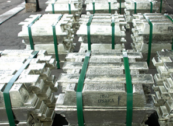
Malaysia Smelting Corporation Berhad (MSC), a tin smelting and smelting company operating in Malaysia, publicly reports Scope 1 and Scope 2 GHG emissions and has also assessed Scope 3 emissions through participation in industry LCA studies.
MSC has committed to achieving net-zero carbon emissions, supporting both the Paris Climate Agreement and Malaysia’s ambition to become a carbon-neutral nation by 2050. The company’s decarbonisation strategy is overseen by its ESG Committee and focuses on energy efficiency, renewable energy adoption and technological innovation to reduce emissions.
The company has implemented a range of decarbonisation initiatives, including transitioning its Pulau Indah smelting operations from LPG and fuel oils to natural gas, installing 1.26 MWp solar photovoltaic panels, introducing real-time energy monitoring systems and upgrading operational processes to reduce energy intensity across operations.
MSC has achieved third-party verified or conforming rating under the Tin Code standards for 2.5 Air Quality, 2.6 Greenhouse Gases and 2.7 Energy Consumption.
Mining Mineral Resources
Mining Mineral Resources (MMR) is an integrated tin mining and smelting company operating in the Democratic Republic of Congo. MMR monitors Scope 1, Scope 2 and Scope 3 GHG emissions as part of its environmental management processes and participation in industry LCA studies.
The company has established a formal Greenhouse Gas Emissions Policy alongside broader Ethical and Environmental Policies, formalising its commitment to sustainable business practices that minimise environmental impact, including carbon footprint reduction, responsible waste management and biodiversity conservation. MMR also operates under an ISO 14001 certified environmental management system.
MMR has achieved third-party verified performance under the Tin Code standards for 2.5 Air Quality
Operaciones Metalurgicas SA.
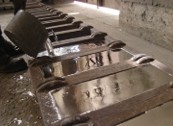
Operaciones Metalúrgicas S.A. (OMSA), an integrated tin mining and smelting company operating in Bolivia, monitors Scope 1, Scope 2 and Scope 3 GHG emissions as part of its environmental management processes and participation in industry LCA studies.
OMSA operates under an Environmental Policy and certified ISO 14001, ISO 9001 and ISO 45001 management systems. Through its Environmental Policy, the company commits to continuously improving environmental performance, preventing pollution, complying with legal requirements and establishing measurable indicators to monitor and minimise the environmental impacts of its operations.
OMSA has achieved third-party verified or conforming rating under the Tin Code standards for 2.5 Air Quality and 2.7 Energy Consumption.
Taboca
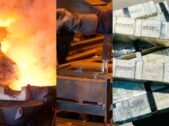
Mineração Taboca S.A. (Taboca), an integrated tin mining and smelting company operating in Brazil, annually tracks and publicly reports Scope 1, Scope 2 and Scope 3 GHG emissions through FGV’s Brazilian GHG Protocol Program, achieving Gold Certification for transparent and independently verified greenhouse gas reporting practices.
Taboca has a Sustainability and Environmental Policy in place which outlines its commitment to reducing emissions, improving resource efficiency, supporting renewable energy use, and continuously strengthening environmental management practices to minimise operational impacts and promote the sustainable use of natural resources.
The company is supporting these commitments through the operation of its own hydroelectric power generation facility, ongoing greenhouse gas monitoring and reporting activities, and continued efforts to strengthen environmental management practices and improve overall operational sustainability across its mining and smelting operations.
Taboca has achieved third-party verified performance under the Tin Code standard for 2.6 Greenhouse Gas Emissions.
Thaisarco
Thailand Smelting and Refining Co., Ltd. (Thaisarco), a tin smelting and refining company operating in Thailand, have assessed Scope 1, Scope 2 and Scope 3 GHG emissions through participation in industry LCA studies.
Thaisarco operates under a publicly available Environmental Policy and certified ISO 14001 environmental management system, supported by a dedicated Energy Management Policy and certified Energy Management System. The company’s policies commit to preventing and minimising environmental impacts from production activities, maintaining pollution control systems and promoting efficient energy management across operations.
Thaisarco has achieved third-party verified performance under the Tin Code standards for 2.5 Air Quality and 2.7 Energy Consumption.
PT Timah
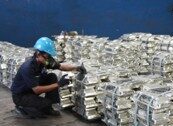
PT Timah Tbk, an integrated tin mining and smelting company operating in Indonesia, tracks and publicly reports Scope 1, Scope 2 and Scope 3 GHG emissions.
PT Timah has established a formal Energy Policy and Decarbonisation Roadmap supporting its commitment to achieving net-zero emissions by 2060. The company has also implemented a Strategic Energy Conservation Plan focused on improving energy management and reducing energy losses, while continuing to strengthen emissions inventory and reporting systems in line with international standards and Indonesian national energy efficiency and environmental policies.
The company is committed to complying with all applicable laws and regulations related to energy efficiency and has implemented a range of decarbonisation initiatives, including the use of renewable and alternative energy sources such as solar photovoltaic systems, natural gas and B35/B40 biodiesel. Further initiatives include gradual electrification of equipment and land rehabilitation and reforestation programmes supporting long-term carbon reduction and sequestration efforts.
PT Timah has achieved third-party verified performance under the Tin Code standards for 2.6 Greenhouse Gas Emissions and 2.7 Energy Consumption.
White Solder
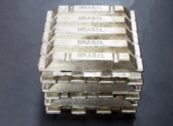
White Solder is an integrated tin mining and smelting company operating in Brazil. The company reports Scope 1, Scope 2 and Scope 3 GHG emissions through its integrated reports. Their inventory is developed in accordance with internationally recognised standards, including the GHG Protocol, ISO 14064-1 and the Brazilian GHG Protocol Program and through participation in industry LCA studies.
White Solder have established a formal climate change commitment outlining an emissions reduction plan and decarbonisation pathway, including a timeline with targets to reduce emissions by 25% by 2033 and a commitment to achieve net-zero emissions by 2050.
The company is supporting these commitments through ongoing decarbonisation initiatives including increasing their renewable energy sourcing which includes prioritising suppliers with cleaner energy sources, and has also implemented a range of emissions reduction initiatives, including the installation of solar panels, the use of lower-emission charcoal sourced from reforestation areas, internal recycling processes, and the recovery and reuse of slag and mining tailings to improve resource efficiency and reduce operational emissions.
White Solder has achieved third-party verified performance under the Tin Code standards for 2.5 Air Quality and 2.7 Energy Consumption in their report published early 2025.
Yunnan Tin Company
Yunnan Tin Company Limited (YTC) is an integrated tin mining and smelting company operating in China. The company publicly reports Scope 1, 2 and 3 GHG.
YTC has established a formal Carbon Peaking Implementation Plan aligned with China’s national climate policy, supporting its commitment to achieve peak carbon emissions by 2030 and drive long-term low-carbon transformation. The company has also strengthened its climate governance through formal energy conservation management measures, cleaner production audits, carbon emissions accounting and reporting systems, and the integration of energy consumption targets into its annual appraisal system.
YTC implements a range of decarbonisation initiatives across its mining and smelting operations, including optimising production systems to improve energy efficiency, reducing fossil fuel consumption through increased use of hydropower, green electricity and natural gas, investing in photovoltaic power generation and waste heat recovery, upgrading equipment and technologies to reduce energy consumption, and strengthening circular economy initiatives focused on waste recovery and resource efficiency.
YTC has achieved third-party verified or conforming rating under the Tin Code standards for 2.5 Air Quality, 2.6 Greenhouse Gas Emissions and 2.7 Energy Consumption.