
Researchers working with Yunnan Tin Group have developed an AI model that estimates tin content in slag using live furnace data, potentially giving operators much faster insight into metal losses than conventional laboratory testing.
 Slag tin content is an important indicator of smelting performance. If too much tin remains in the slag, valuable metal is being lost rather than recovered as crude tin.
The challenge is that slag tin is not normally measured continuously. In the industrial furnace used for this study, process data were recorded every minute, while slag tin content was measured in the laboratory only around once every three hours.
Turning furnace data into a virtual measurement
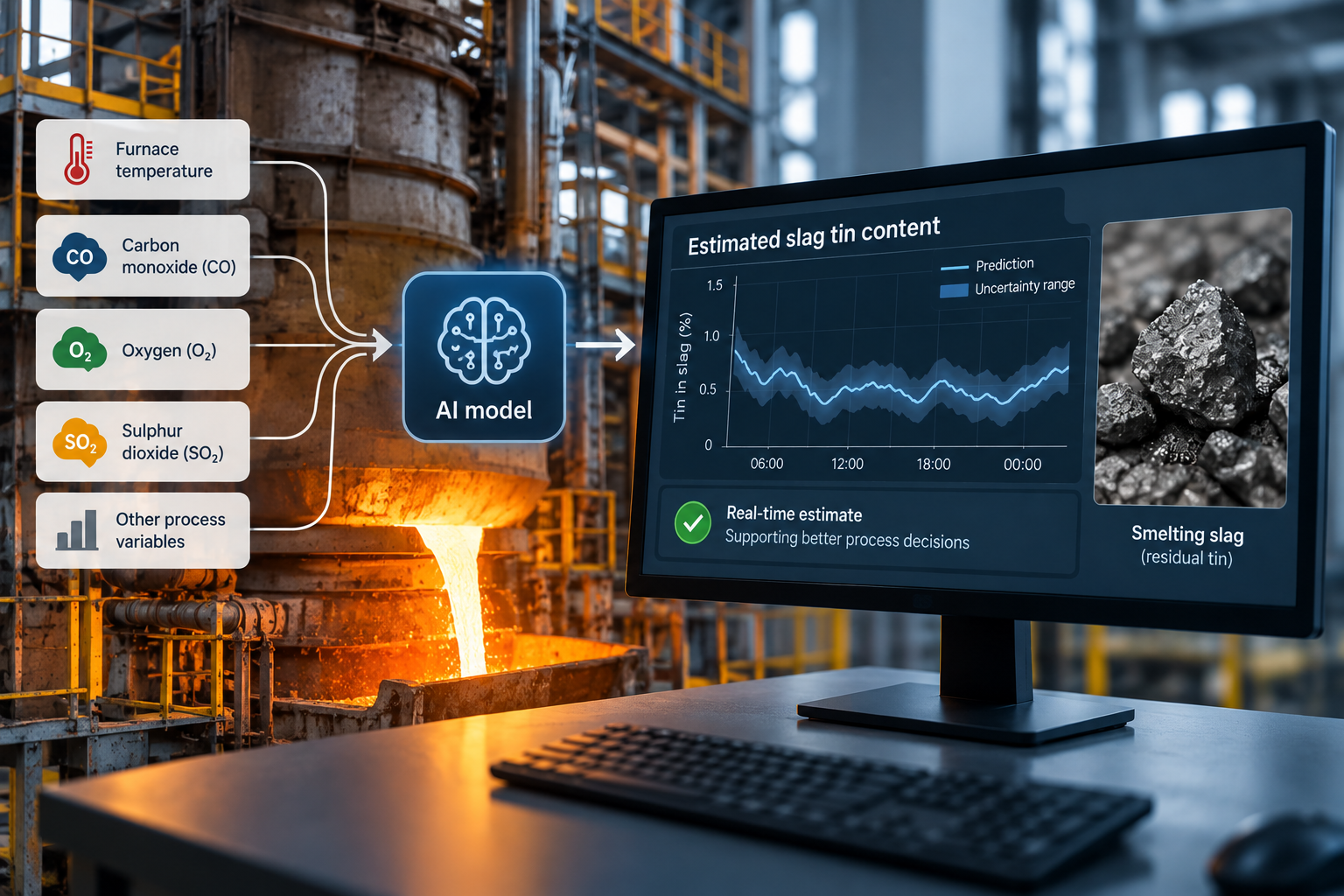
Researchers from Yunnan Tin Group, Yunnan University and Central South University developed a “soft sensor” that estimates slag tin content from continuously recorded furnace data.
The model uses measurements including temperature and concentrations of carbon monoxide, oxygen and sulphur dioxide. These variables provide information on furnace conditions and the reducing atmosphere responsible for converting tin oxide into metallic tin.
Unlike a purely data-driven model, the system also incorporates basic metallurgical knowledge. Stronger reducing conditions would generally be expected to lower the amount of tin left in slag, and the model is trained to favour predictions that follow this relationship.
Tested on industrial operating data
The model was tested using 30 days of data from an operating top-blown tin smelting furnace, including 43,200 one-minute process measurements and 240 laboratory slag assays.
On the held-out test period, the model achieved an R² value of 0.889 and the lowest prediction error among the methods assessed. It also produced uncertainty estimates, allowing the system to indicate when a prediction may be less reliable.
More frequent estimates of slag tin content could help operators identify periods of poorer recovery earlier, rather than waiting several hours for the next laboratory result.
Towards smarter process monitoring
The researchers are careful to note that the study is based on only one month of operation from a single furnace. Further validation would be needed across longer campaigns, different feed conditions and other furnaces before the approach could be considered ready for wider industrial use.
Even so, the work provides an interesting example of how AI could use existing furnace measurements to support faster process decisions and improve visibility of tin recovery during smelting.