
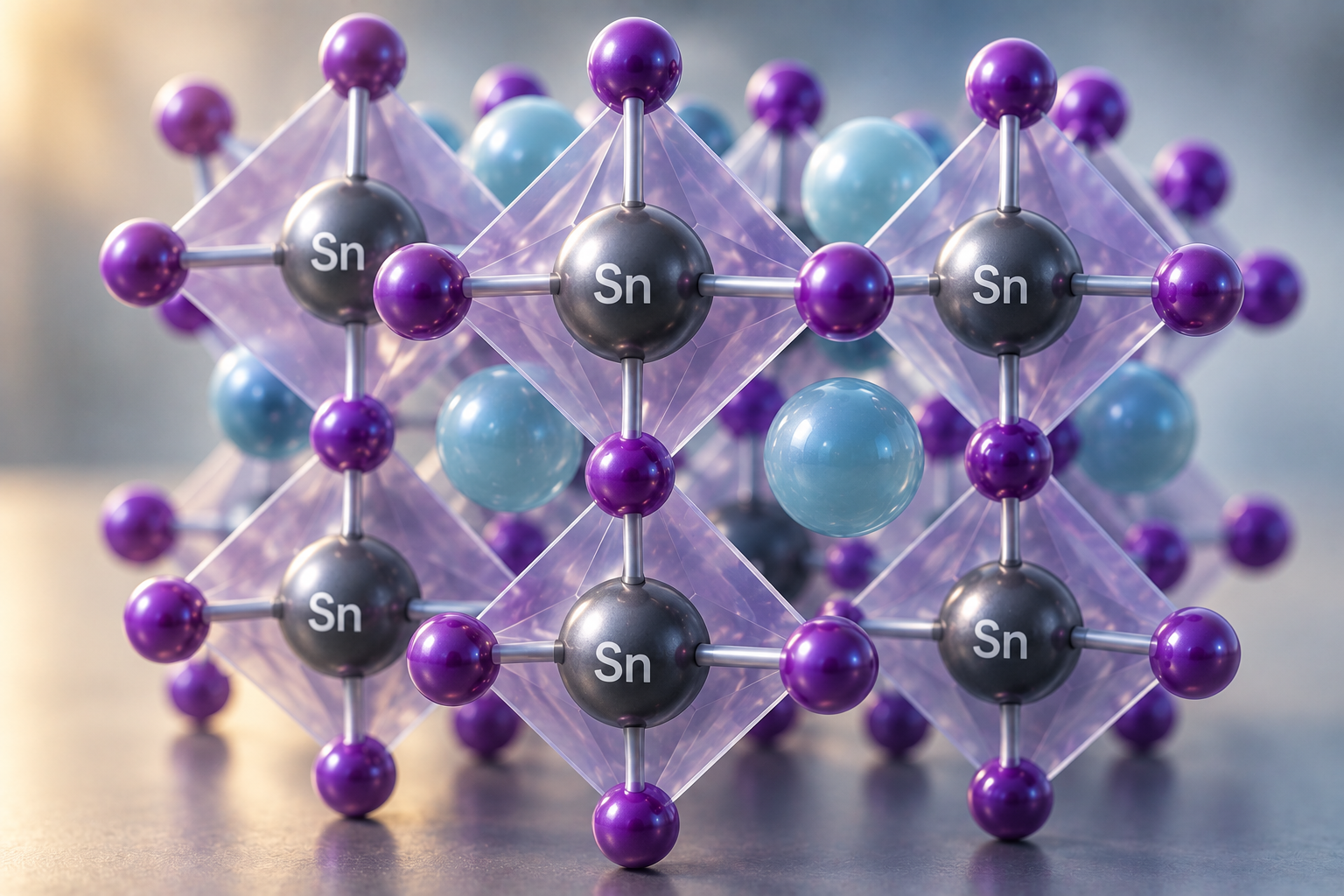
Researchers have uncovered why tin-based perovskites can retain energy from sunlight for unusually long periods — a property that could make them promising materials for a future generation of high-efficiency solar cells.
 Conventional solar cells cannot capture all the energy carried by sunlight. When light excites charge carriers within a solar material, they initially contain excess energy, but much of this is rapidly lost as heat as the carriers cool.
Hot-carrier solar cells are an emerging concept designed to capture these carriers before that excess energy is lost. In theory, this could allow solar cells to make use of more of the energy available from sunlight.
The challenge is that charge carriers normally cool within picoseconds, leaving very little time to capture their excess energy.
Tin-based perovskites are unusual because previous experiments have shown that their charge carriers can remain hot for much longer, in some cases into the nanosecond range. Researchers from the University of Groningen and TU Wien have now investigated why.
Why tin helps keep carriers hot
The study identifies two effects that work together to slow energy loss.
The first, known as band filling, occurs as excited charge carriers move into lower-energy states. As these states become occupied, there is less space available for other carriers to move into, making further energy loss more difficult.
This effect is particularly strong in tin-based perovskites because of their electronic properties, including their relatively low effective carrier mass.
The second effect involves vibrations within the crystal structure. Charge carriers normally transfer energy into these vibrations, which is eventually lost as heat. In perovskites, however, some of this vibrational energy can be transferred back to the carriers before it dissipates, further slowing the cooling process.
When the researchers combined these two effects in computer simulations, the difference was substantial.
For a model with properties similar to the tin perovskite caesium tin iodide (CsSnI₃), the fitted cooling time increased from around 4 picoseconds to approximately 470 picoseconds under the simulated conditions.
This was compared with previous experimental measurements of CsSnI₃, which reported a slow cooling component of around 636 picoseconds under different conditions. The model was not designed to reproduce the experiment exactly, but the similar timescales suggest that the two mechanisms can explain much of the unusually slow cooling observed in tin perovskites.
The simulations also showed that the carriers remain genuinely hot during this extended period, rather than simply appearing more energetic because lower-energy states have become occupied.
A potential route to higher-efficiency solar cells
The findings help explain why tin-based perovskites are attracting interest for future hot-carrier solar cells.
The researchers identify a low effective carrier mass, a soft crystal lattice and high material purity as important characteristics for materials designed to slow carrier cooling. On this basis, they specifically highlight tin-based perovskites as promising candidates for further investigation.
The work remains at a fundamental research stage. It does not demonstrate a working hot-carrier solar cell, and efficiently extracting these energetic carriers before they cool remains a key challenge.
However, by explaining why tin-based perovskites can retain this energy for unusually long periods, the study provides a clearer understanding of how tin could contribute to future solar technologies designed to capture more of the energy available from sunlight.
For more developments in emerging tin technologies, visit Tin Valley.