
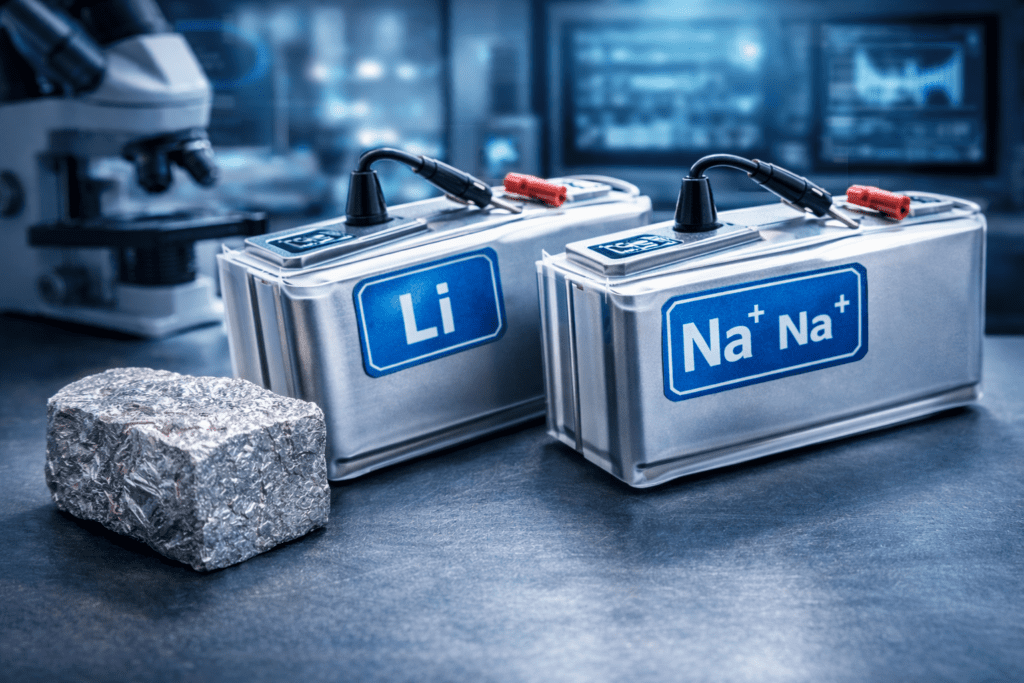
 Hungarian startup Edortech Ltd. has unveiled its patented ONLi anode platform, a new tin-based metal-alloy system designed for both lithium-ion and sodium-ion batteries.
The technology, developed over more than a decade at the Bay Zoltán Research Institute, is reported to be ready for scaled manufacturing following independent performance audits.
The core of the anode technology is a proprietary tin-alloy layer bonded to a conventional copper foil electrode with direct diffusion.
The new approach eliminates all the expensive slurry casting and energy-intensive drying steps typically used to make anodes, instead using classical metallurgical processes. This simplifies production, reduces water and energy consumption, and enables integration into existing battery production lines without major process changes.
Tin stores charge through alloying reactions, forming Li–Sn or Na–Sn phases. In sodium-ion batteries, tin offers a theoretical gravimetric capacity of approximately 847 mAh g⁻¹, significantly higher than hard carbon (~250–300 mAh g⁻¹), the current commercial standard.
In lithium-ion systems, graphite is limited to 372 mAh g⁻¹, whereas tin offers a theoretical gravimetric capacity of 994 mAh g-1. In addition, tin’s relatively high density (~7.3 g cm⁻³) supports strong volumetric energy density, an essential parameter for electric vehicles and compact energy storage systems.
According to Edortech, ONLi can deliver up to 70% higher energy density and roughly 1.8 times the capacity compared with conventional graphite or silicon–carbon anodes in Li-ion systems. The company has indicated that major cell manufacturers and automotive OEMs are evaluating the material.
For the battery industry, a simple, scalable tin-alloy anode compatible with current gigafactory infrastructure could offer a pathway to higher-performance lithium- and sodium-ion cells without disruptive capital expenditure. For sodium-ion technology, where increasing energy density remains critical to wider adoption, tin’s high capacity could materially narrow the gap with established lithium chemistries.
ONLi highlights the growing strategic role of tin in advanced battery systems, reinforcing its potential contribution to both enhanced performance and more efficient manufacturing across global energy storage markets.
To network with both members of the tin and battery industries, visit Tin Valley.